Showing posts with label flag. Show all posts

Thursday, October 7, 2010

The Language of Flags (Navy Memorial)

Signal flags adorning a ship mast at the US Navy Memorial (across from the National Archives), September 2010. The International Code of Signals designates a flag for each letter in the Roman alphabet, plus each Arabic numeral (see here for more). Ships use such flags to communicate important messages to one another on the sea.

P.S. You can see some earlier posts for other takes on "the language of flags" - i.e., the special language that is used in order to describe flags, and the ways flags themselves can communicate symbolic meanings.

P.P.S. No, I don't know what these flags say! If anyone knows the code, let me know...

Tuesday, October 5, 2010

Library of Congress Logo (Banner)

Just noticed today that the Library of Congress logo looks like a waving American flag, as well as an open book. Very cool.

(For more on different adaptations of the American flag, see this recent posting.)

Sunday, October 3, 2010

The Language of Flags (Star-Spangled Banners)

The huge, tattered flag that inspired the lyrics of "The Star Spangled Banner" (the US National Anthem) is indeed a "star attraction" at the National Museum of American History (the screenshot above is a detail from a page on the online "Star Spangled Banner" exhibition). The huge flag on display was flown over Fort McHenry and survived the War of 1812, and it bears 15 stars and 15 stripes - representing the 13 original colonies, plus the 2 additional states (Kentucky and Vermont) that had joined the Union by that time. (The original plan was to keep adding 1 star and stripe for each new state that was admitted, but at some point this became too unwieldy and the number of stripes was "fixed" at 13.)

This website (as of September 2010) indicates that there's a Spanish translation of the anthem lyrics on display alongside the flag. (Note that this is NOT the same as the Spanish version that made the news back in 2006 - listen to the story here.)

Another intriguing version of the US flag in the NMAH is this Civil War era banner: the regimental colors of the 84th Infantry, 1866. This regiment was formed from the Corps d'Afrique of Louisiana, comprising of free black soldiers who fought for the Union. Note the French-derived place names on the red stripes (you can read more about this flag here and here). Interestingly, the writing in this flag is "backwards" - it reads left to right with the blue part (canton) on the right. As I understand it, the flag is typically flown facing the other direction (with canton on left).

A more stylized version of the "backwards" flag can be seen on this sign outside Newseum during Obama's inauguration in January 2009. (The number refers to Obama as the 44th President of the US.)

These versions of the US flag were displayed on the east façade of the Capitol when Obama was inaugurated in January 2009. The flags on the outside are the original stars and stripes (13 stars in a ring). The flag in the center is the current flag (50 stars). The other flags have 21 stars: this what the US flag looked like just after Illinois (Obama's home state) entered the Union in 1818.

As is the case with other flags, the "Star-Spangled Banner" is sometimes modified in order to make a political message. See, for instance, the protest flags here and here.

Saturday, October 2, 2010

"One Nation" Logo

A timely follow-up to yesterday's posting about flags: this sign for the "One Nation Working Together" March on DC. Today, October 2, 2010, marks the progressive, social justice answer to the Glenn Beck/FOX News rally that was in town a few weeks ago. Appropriately, the logo features a stylized American flag with the numeral "1" as the basis for a stylized "N" (for "nation").

(You can learn more about the march and the coalition of groups that make up the organization at this website).

Friday, October 1, 2010

The Language of Flags - US States etc.

This city abounds with flags - and not just in government buildings. In front of Union Station you can see the flags of all 50 states in the order they were admitted into the Union. Above (from L to R), the most recent states (Oklahoma, New Mexico, Arizona, Alaska, and Hawaii), then DC, and finally all the other US territories and commonwealths (Puerto Rico, Guam, American Samoa, US Virgin Islands, and Northern Mariana Islands).

Vexillology, the study of flags, employs an arcane lexicon that ultimately derives from medieval heraldry (see this website for some of this vocabulary). I would describe the Hawaiian flag (just right of center in the photo above) as something like "the British flag in the top-left corner with stripes on the rest of it" but the flag is officially described in these terms:

(3) A red cross bordered with white is charged (placed) over all.
[From The Hawaii Revised Statues, Vol. 1, Ch. 5, Sec. 19 - see here]

The DC flag, above (center), is commonly understood to have heraldic origins (see my earlier posting for a fuller description).

I think that the most attractive use of flags as a decorative motif in a building is in the Kennedy Center. In the grand Hall of Nations, flags appear in alphabetical order by country name. Above, we see Australia (top left) followed by A's and B's.

In the equally-grand Hall of States, the flags are arranged chronologically according to date they were admitted into the Union. The flags begin with Delaware (in the back right) and proceed toward the front of the right-hand wall; they they start up again on the left-hand wall (front left of this photo) and proceed to the end, followed by the US "non-states."

For more on each of the 50 state flags, see this website.

Wednesday, September 29, 2010

The Language of Flags - DC

Above, the distinctive flag of the District of Columbia. Its stars and stripes evoke the US (federal) flag, but most descriptions say the DC flag design derives from the coat of arms of George Washington's family (see here for more on the flag's origins).

Here's the Washington family shield as it appears in 14th-century stained glass on a window in Selby Abbey, Yorkshire (England). In proper heraldic vocabulary, these design motifs should be designated as "mullets and bars" and not "stars and stripes" (see the last section of this page). For more about the Washington Window at Selby Abbey, see here. For an extensive website exploring the rich legacy of Washington's arms in American culture, see here.

I was trying to find out more about the symbolism of the DC flag but the website on DC symbols wasn't that informative. For what it's worth, I have heard somewhere (was it on a Capitol tour?) that the three stars represent the branches of government (executive, legislative, and judicial) and bars symbolize equality. This could be an urban legend or even some sort of ironic political commentary - since DC residents lack equal legislative representation in Congress (i.e., DC has no voting representative). For more on the DC voting rights issue and how the flag is used on both sides of the issue, see this alternate version of the DC flag and this DC license plate).

Creative Logo (Department of Transportation)

Today I spotted this logo on a construction vehicle as workers were repaving part of the street. The logo bears the DC flag, and below a lower-case "d" and a punctuation mark (period). District Department of Transportation = D-DOT. Get it? (This logo also appears on the D-DOT website.) Capitol Hill.

(For another use of the DC flag, see this license plate.)
 
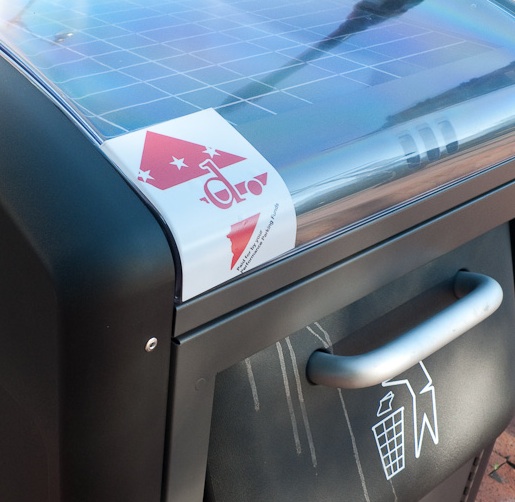
[Added Oct 1, 2010] Just noticed this brand new solar trash compactor (yes, this is what DC tax dollars pay for!) at Eastern Market. A snazzier version of the D-DOT logo superimposed upon a DC flag (colors reversed) and a map indicating the shape of the District.