Calliope (muse of heroic poetry), as sculpted Austin Pajou (c. 1763), in the French Neoclassical style. The name for Calliope comes from the Greek Καλλιόπη (Kalliope, or "beautiful-voiced"), and she is conventionally depicted holding a book or tablet.
In this detail, we see that the sculptor has chosen to show her holding an open book. On these pages are a Latin inscription. The first 3 lines on the left-hand page read CALLIOPE REGI/NA HOMINVM / DIVVMQVE (Calliope, Queen of Humans and Gods). The "queen" form of address is an allusion to Horace, whose Latin poetry refers to Calliope as regina, or queen (Carminae, III.iv.2). National Gallery of Art, West Wing.
To read more about this sculpture (including a full transcript of the Latin inscription), see here.
Showing posts with label literature. Show all posts
Tuesday, January 18, 2011
Wednesday, January 12, 2011
Trans-Atlantic Poetry (Navy Memorial Metro)
Two poems are inscribed all the wall in part of Ocean Piece, an artwork by Jorge Martin (1995). As far as I can tell, the artwork honors trans-Atlantic navigation and exploration. On the left (Western?) side of the artwork is an excerpt from Walt Whitman's poem "The Prayer of Columbus." The lines read:
All my emprises have been fill’d with Thee,
My speculations, plans, begun and carried on in thoughts of Thee,
Sailing the deep, or journeying the land for Thee;
Intentions, purports, aspirations mine—leaving results to Thee.
O I am sure they really come from Thee!
The urge, the ardor, the unconquerable will,
The potent, felt, interior command, stronger than words,
A message from the Heavens, whispering to me even in sleep,
These sped me on.
By me, and these, the work so far accomplish’d (for what has been, has been);
By me Earth’s elder, cloy’d and stifled lands, uncloy’d, unloos’d;
By me the hemispheres rounded and tied—the unknown to the known.
With two hands - Deed and Fate
We have unveiled in the same gesture, one
Raises the flickering and divine torch
While the other draws the veil aside.
Whether the hour was ripe or it owned
The hand that tore the Western veil,
Science was the soul and Audacity the body
Of the hand that unveiled it.
Whether the hand rose the glittering torch
Out of Fortune, Will or Tempest,
God was the soul and Portugal the body
Of the hand that bore it.
This artwork was a gift from the Lisbon Subway to the DC Metro (see this website for more). The oceanic and transportation-themed artwork is indeed fitting for its location: the Navy Memorial metro station.
Labels:
architecture,
art,
culture,
literature,
metro,
national archives,
navy memorial,
portuguese,
sculpture,
transportation
Tuesday, September 28, 2010
German, American, and Chinese Poems (Community)
I've walked passed the Goethe-Institut in Chinatown many times (see an earlier post), but usually I keep on walking. A few days ago, something caught my eye: these posters displaying German, American, and Chinese poems. These posters are part of "Time Shadows," an annual competition that features poems from each culture. The theme for 2010 is "Community."
This Chinese poem by a poet from Taiwan is entitled 望夫石 ("Husband-Gazing Stone"). The German translation states that this poem concerns "die Legende von der Ehefrau, die so lange nach ihrem verschollenen Ehemann Ausschau hielt, bis sie sich in einen Stein verwandelte" [the legend of a wife who kept watch for her missing husband for so long that she transformed into a stone]. You can read the poem and its English and German translations at this website.
I found this excerpt from the work of an American poet particularly interesting. This poem, entitled "Locals," reminds us that all of our ancestors ultimately come from "somewhere else," displacing whoever was there before. The poem offers an insightful commentary on the ever-shifting nature of community and the constant migration of people over time and space. The final 2 stanzas in the original English text read as follows:
Bedouin-Brython-Algonquins; always there
before you; the original prior claim
that made your being anywhere intrusive.
There, doubtless, in Eden before Adam
wiped them out and settled in with Eve.
Whether at home or away, whether kids
playing or saying what they wanted,
or adults chatting, waiting for a bus,
or, in their well-tended graves, the contented dead,
there were always locals, and they were never us.
See this website for the entire poem in English, plus translations in Chinese and German.
For a poem from the "Time Shadows 2009" competition (the theme was "City Life"), see this earlier post or this website.
This Chinese poem by a poet from Taiwan is entitled 望夫石 ("Husband-Gazing Stone"). The German translation states that this poem concerns "die Legende von der Ehefrau, die so lange nach ihrem verschollenen Ehemann Ausschau hielt, bis sie sich in einen Stein verwandelte" [the legend of a wife who kept watch for her missing husband for so long that she transformed into a stone]. You can read the poem and its English and German translations at this website.
I found this excerpt from the work of an American poet particularly interesting. This poem, entitled "Locals," reminds us that all of our ancestors ultimately come from "somewhere else," displacing whoever was there before. The poem offers an insightful commentary on the ever-shifting nature of community and the constant migration of people over time and space. The final 2 stanzas in the original English text read as follows:
Bedouin-Brython-Algonquins; always there
before you; the original prior claim
that made your being anywhere intrusive.
There, doubtless, in Eden before Adam
wiped them out and settled in with Eve.
Whether at home or away, whether kids
playing or saying what they wanted,
or adults chatting, waiting for a bus,
or, in their well-tended graves, the contented dead,
there were always locals, and they were never us.
See this website for the entire poem in English, plus translations in Chinese and German.
For a poem from the "Time Shadows 2009" competition (the theme was "City Life"), see this earlier post or this website.
Tuesday, September 7, 2010
Florence Edition: Dante
It's been months since I posted anything new here - much of the summer was spent away from DC. Just for fun, I'll be blogging about a few of the places I visited. I start with Florence.
The theme for this blog entry about Florence is Dante: signs of this renowned poet (d. 1321) can be found all throughout the city.
A detail of Dante's book reveals the opening lines of his poem. A little hard to read, since 1. the text appears in all capital letters with no word separations and 2. the spelling differs from most modern editions. The first page (left) reads: "Nel mezzo del chamino di nostra vita / Mi ritrova per una selva scura che la diritta via era smarita" [In the middle of our life's journey / I found myself in a dark wood, for the straight path was lost].
Many other signs evoking the works of Dante are strategically placed around the city; e.g., at one point along the Ponte Vecchio (Old Bridge) crossing the Arno River, we see "in sul passo d'Arno" [at the crossing of the Arno]. Mildly interesting sign, I guess - but without any real context for the quote it seems pretty random. I wonder if most people even notice it.
One place of particular interest for Dante readers is the Casa di Dante, where the poet (most likely) once resided. There's much to love about this wall display - not only does it have a nice diagram of all of Dante's circles of hell, but it also manages to squeeze in the entire text of The Divine Comedy on a single panel in tiny font! And how did those footprints get on the wall?
A Florence location that has become a curious site of pilgrimage is the Chiesa di Santa Margherita de' Cerchi, which is allegedly near the place where Dante first met his beloved Beatrice Portinari (i.e., the subject of his early poetry and, later, his guide in the Paradiso). The entrance sign informs visitors that the church dates from 1032 and Beatrice was buried here.
Inside the church, a painting: "Dante meets Beatrice P., accompanied by her mother Cilia de' Caponsacchi and Monna Tessa" [i.e., nurse in the Portinari household]. In the Vita Nuova, Dante claims he met Beatrice walking down the street with two ladies and this encounter inspired him to write poetry about her. This painting seems to take some liberties here, as Dante claims he was 18 at the time of that meeting (this Dante looks much older).
At the tomb of Beatrice, visitors from around the world leave handwritten letters to her (most of these are written by women who are seeking love and asking Beatrice to intercede). I can't make out all the text here, but the one on the right is in Korean; the one of the left (with lipstick) reads "Dear Beatrice."
The "letters for Beatrice" phenomenon is mysterious and surprisingly recent in origin. For more on Dante's life and work (emphasis on The Divine Comedy), see this excellent website.
P.S. There is a Florence-DC connection I should note! In Meridian Park, you can see a statue of Dante clearly based on the painting in the Duomo (or something very much like it):
This portrayal of Dante looks pretty familiar. I see one major difference between this sculpture and the Duomo painting, though. The Dante in the Duomo holds an open book, but this Dante has his book closed.
The theme for this blog entry about Florence is Dante: signs of this renowned poet (d. 1321) can be found all throughout the city.
In the Duomo, this spectacular painting (Domenico di Michelino, 1465) depicts the poet gazing longingly at the city of Florence (he wrote The Divine Comedy while in exile from his beloved home). On the left you see the Inferno and center is Mount Purgatory (as described in the Purgatorio). The celestial spheres of Paradiso are above. This painting beautifully transforms (translates, if you will) the grand scope of the poet's allegory into a clear visual format - although it depicts a city with architecture that Dante would not have known (the dome did not exist as such in his day).
Many other signs evoking the works of Dante are strategically placed around the city; e.g., at one point along the Ponte Vecchio (Old Bridge) crossing the Arno River, we see "in sul passo d'Arno" [at the crossing of the Arno]. Mildly interesting sign, I guess - but without any real context for the quote it seems pretty random. I wonder if most people even notice it.
One place of particular interest for Dante readers is the Casa di Dante, where the poet (most likely) once resided. There's much to love about this wall display - not only does it have a nice diagram of all of Dante's circles of hell, but it also manages to squeeze in the entire text of The Divine Comedy on a single panel in tiny font! And how did those footprints get on the wall?
A Florence location that has become a curious site of pilgrimage is the Chiesa di Santa Margherita de' Cerchi, which is allegedly near the place where Dante first met his beloved Beatrice Portinari (i.e., the subject of his early poetry and, later, his guide in the Paradiso). The entrance sign informs visitors that the church dates from 1032 and Beatrice was buried here.
Inside the church, a painting: "Dante meets Beatrice P., accompanied by her mother Cilia de' Caponsacchi and Monna Tessa" [i.e., nurse in the Portinari household]. In the Vita Nuova, Dante claims he met Beatrice walking down the street with two ladies and this encounter inspired him to write poetry about her. This painting seems to take some liberties here, as Dante claims he was 18 at the time of that meeting (this Dante looks much older).
At the tomb of Beatrice, visitors from around the world leave handwritten letters to her (most of these are written by women who are seeking love and asking Beatrice to intercede). I can't make out all the text here, but the one on the right is in Korean; the one of the left (with lipstick) reads "Dear Beatrice."
The "letters for Beatrice" phenomenon is mysterious and surprisingly recent in origin. For more on Dante's life and work (emphasis on The Divine Comedy), see this excellent website.
P.S. There is a Florence-DC connection I should note! In Meridian Park, you can see a statue of Dante clearly based on the painting in the Duomo (or something very much like it):
This portrayal of Dante looks pretty familiar. I see one major difference between this sculpture and the Duomo painting, though. The Dante in the Duomo holds an open book, but this Dante has his book closed.
Labels:
architecture,
church,
florence,
italian,
korean,
literature,
medieval,
museum,
painting,
religion
Sunday, April 25, 2010
Chaucer in DC (Modern English Translation)
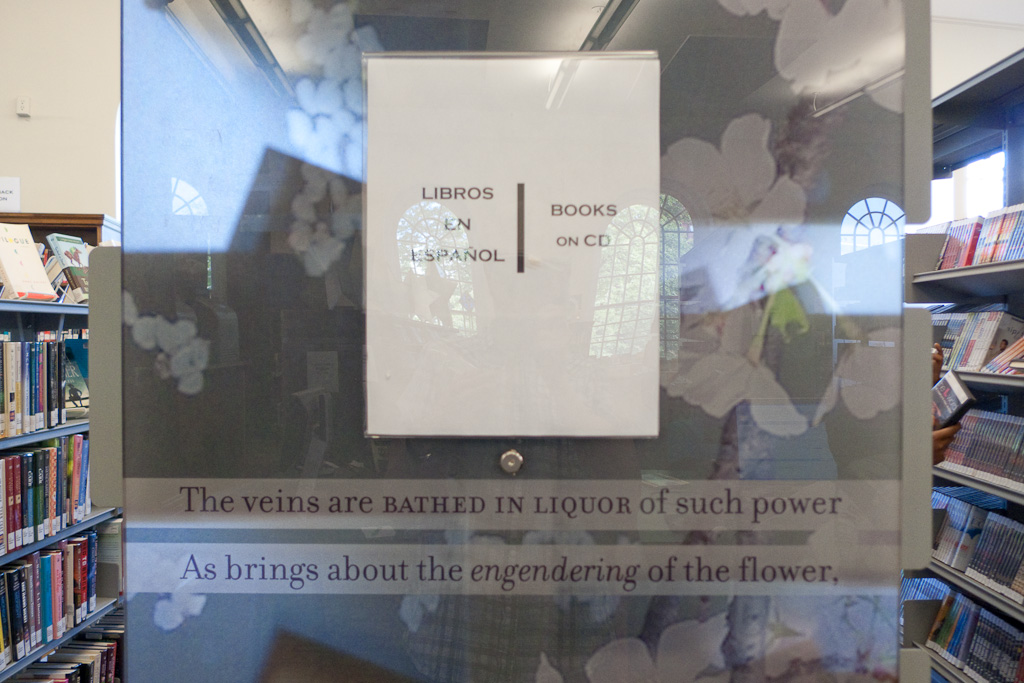
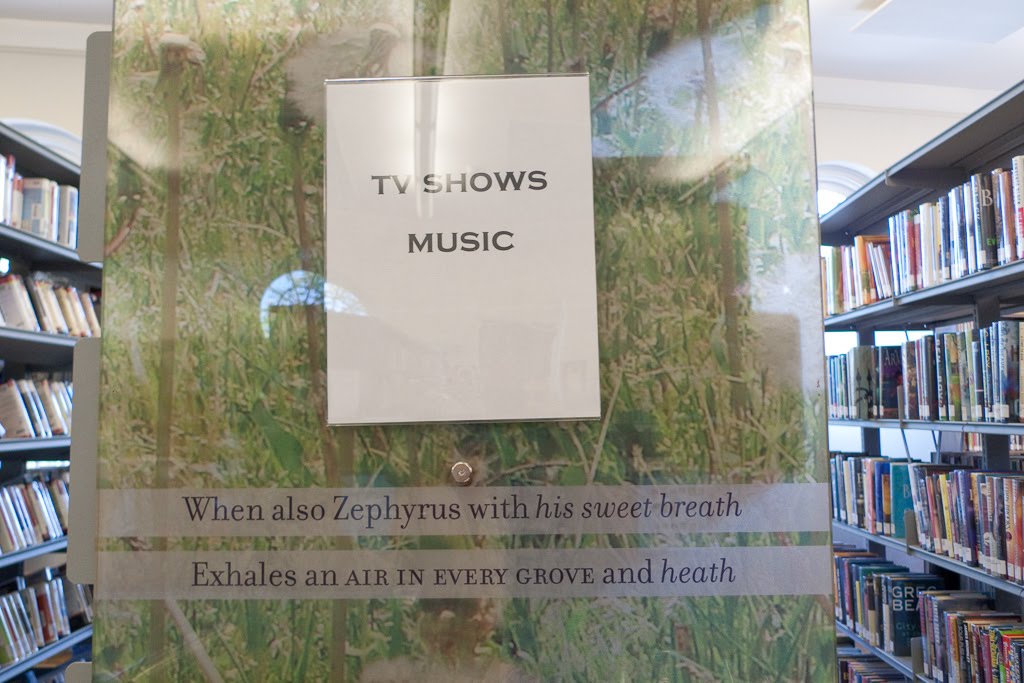
Yesterday I popped into the DC Public Library, SE Branch and noticed an intriguing decorative motif: April-themed lines from Geoffrey Chaucer's The Canterbury Tales adorned the bookshelves (original Middle English along one set of bookcases, and a modern English translation on the other). Above, a snippet from the original text. Let's take a closer look at the translation, shall we?
"What that Aprille with his shoures soote/The droght of March hath perced to the roote" = When in April the SWEET SHOWERS FALL/And pierce the drought of March to the root, & all [I don't know why random words are in italics or capital letters. Overall it's pretty good; interesting that "the sweet showers" are now the grammatical subject, not April itself (himself)].
"And bathed every veyne in swich licour/Of which vertu engendred is the flour" = The veins are BATHED IN LIQUOR of such power/As brings about the engendering of the flower [seems pretty good - nice translation of "vertu" as "power" in order to make the lines rhyme].
"Whan Zephirus eek with his sweete breeth/Inspired hath in every holt and heeth" = When also Zephyrus with his sweet breath/Exhales AN AIR IN EVERY GROVE and heath [the words "breath" and "heath" don't rhyme in modern English, but otherwise this works].
"The tendre croppes, and the yonge sonne/Hath in the Ram his halve cours yronne" = UPON THE TENDER SHOOTS, and the young sun/His HALF-COURSE IN THE SIGN of the Ram HAS RUN [the "in the sign of the Ram" clarifies things for modern readers but the capital letters have gone crazy!].
"And smale foweles maken melodye,/That slepen al the nyght with open ye" = And the small fowl are making melody/That SLEEP AWAY THE NIGHT with open eye [here "melody" and "eye" no longer rhyme - not quite sure why "fowls" or "birds" wasn't used].
"(So priketh hem Nature in hir courages)/Than longen folk to goon on pilgrimages" = (So nature pricks them AND THEIR HEART ENGAGES)/Then PEOPLE LONG TO GO ON pilgrimages [creative translation here; "engages" works relatively well to set up the word "pilgrimages"].
"And palmeres for to seken straunge strondes,/To ferne halwes, kowthe in sondy londes" = And PALMERS LONG TO SEEK the stranger strands/Of far-off saints, hallowed in sundry lands [the phrase "stranger strands" and insertion of "saints" here is slightly odd, but I like the reincorporation of longing in this couplet].
"And specially from every shires ende/Of Engelond to Caunterbury they wende" = And specially, from every shire's end/Of England, down to Canterbury THEY WEND [I think it would have made more sense to translate "specially" as "especially" or "particularly"].
Overall, quite good - some awkward moments, but the modernization does attempt to preserve the original rhyme pattern.
P.S. Note that the final couplet to the opening lines has been omitted: "The hooly bilsful martir for to seke,/That hem hath holpen, whan that they were seke" [To seek the holy blissful martyr, who has helped them (pilgrims/palmers) whenever they were sick]. Not quite sure why these last two lines have been left out. Did the library simply run out of shelves? This is a public library, and I wonder (this being DC) if the lines were left out in order to preserve a more secular, nonsectarian theme and avoid the appearance of endorsing any particular religion.
"What that Aprille with his shoures soote/The droght of March hath perced to the roote" = When in April the SWEET SHOWERS FALL/And pierce the drought of March to the root, & all [I don't know why random words are in italics or capital letters. Overall it's pretty good; interesting that "the sweet showers" are now the grammatical subject, not April itself (himself)].
"And bathed every veyne in swich licour/Of which vertu engendred is the flour" = The veins are BATHED IN LIQUOR of such power/As brings about the engendering of the flower [seems pretty good - nice translation of "vertu" as "power" in order to make the lines rhyme].
"Whan Zephirus eek with his sweete breeth/Inspired hath in every holt and heeth" = When also Zephyrus with his sweet breath/Exhales AN AIR IN EVERY GROVE and heath [the words "breath" and "heath" don't rhyme in modern English, but otherwise this works].
"The tendre croppes, and the yonge sonne/Hath in the Ram his halve cours yronne" = UPON THE TENDER SHOOTS, and the young sun/His HALF-COURSE IN THE SIGN of the Ram HAS RUN [the "in the sign of the Ram" clarifies things for modern readers but the capital letters have gone crazy!].
"And smale foweles maken melodye,/That slepen al the nyght with open ye" = And the small fowl are making melody/That SLEEP AWAY THE NIGHT with open eye [here "melody" and "eye" no longer rhyme - not quite sure why "fowls" or "birds" wasn't used].
"(So priketh hem Nature in hir courages)/Than longen folk to goon on pilgrimages" = (So nature pricks them AND THEIR HEART ENGAGES)/Then PEOPLE LONG TO GO ON pilgrimages [creative translation here; "engages" works relatively well to set up the word "pilgrimages"].
"And palmeres for to seken straunge strondes,/To ferne halwes, kowthe in sondy londes" = And PALMERS LONG TO SEEK the stranger strands/Of far-off saints, hallowed in sundry lands [the phrase "stranger strands" and insertion of "saints" here is slightly odd, but I like the reincorporation of longing in this couplet].
"And specially from every shires ende/Of Engelond to Caunterbury they wende" = And specially, from every shire's end/Of England, down to Canterbury THEY WEND [I think it would have made more sense to translate "specially" as "especially" or "particularly"].
Overall, quite good - some awkward moments, but the modernization does attempt to preserve the original rhyme pattern.
P.S. Note that the final couplet to the opening lines has been omitted: "The hooly bilsful martir for to seke,/That hem hath holpen, whan that they were seke" [To seek the holy blissful martyr, who has helped them (pilgrims/palmers) whenever they were sick]. Not quite sure why these last two lines have been left out. Did the library simply run out of shelves? This is a public library, and I wonder (this being DC) if the lines were left out in order to preserve a more secular, nonsectarian theme and avoid the appearance of endorsing any particular religion.
Labels:
culture,
eastern market,
library,
literature,
medieval
Thursday, April 8, 2010
Library of Congress: Inventors of Writing (Odin)
Here's one last figure from the bronze doors to the Adams Building (Library of Congress). Here we see Odin (Óðinn in Old Norse), the Germanic god; I assume he's on this wall because he's believed to have invented runes or something...but don't know much about Norse mythology.
To read about some of the other figures on these doors, see here and here.
Labels:
architecture,
art,
capitol hill,
culture,
library,
library of congress,
literature,
medieval,
museum,
norse
Library of Congress: Inventors of Writing (Cadmus)
Here's another figure from the bronze doors on the Adams Building (Library of Congress). Here we see Cadmus (Κάδμος), the man who - according to the historian Herodotus - introduced the alphabet (Phoenician script) to the ancient Greeks. Interesting that the sculptor here (Lee Lawrie, 1939) made no attempt to replicate Greek letters (i.e., the name "CADMUS" is written in Roman capitals).
For more images from the bronze doors, see the previous post.
For more Greek stuff from the Library of Congress, see this posting.
For more images from the bronze doors, see the previous post.
For more Greek stuff from the Library of Congress, see this posting.
Labels:
architecture,
art,
capitol hill,
culture,
greek,
library,
library of congress,
literature,
museum
Wednesday, April 7, 2010
Library of Congress: Inventors of Writing (Cang Jie)
The bronze doors on the west side of the Adams Building of the Library Congress depict mythological and historical figures who are (for some reason or another) closely associated with writing. Above, a figure representing 倉頡 (Cāng Jié), the legendary four-eyed inventor of Chinese characters.
There are two different systems for writing Mandarin Chinese characters, including traditional and simplified; in simplified script the name is written 仓颉. Note that there are (at least) two systems of Romanization for Chinese. The spelling "Ts'ang Chieh" (used in this inscription) is the antiquated Wide-Giles system which has since fallen out of use; it's generally considered standard procedure to use Pinyin Romanization.
P.S. The bronze doors were sculpted by Lee Lawrie in 1939.
For more figures from these bronze doors, see the following post.
There are two different systems for writing Mandarin Chinese characters, including traditional and simplified; in simplified script the name is written 仓颉. Note that there are (at least) two systems of Romanization for Chinese. The spelling "Ts'ang Chieh" (used in this inscription) is the antiquated Wide-Giles system which has since fallen out of use; it's generally considered standard procedure to use Pinyin Romanization.
P.S. The bronze doors were sculpted by Lee Lawrie in 1939.
For more figures from these bronze doors, see the following post.
Labels:
architecture,
art,
capitol hill,
chinese,
culture,
library,
library of congress,
literature,
museum
Monday, February 22, 2010
Used Book Store Signage (SPOILER ALERT)
I visited a certain used book store near Eastern Market today and was entertained by its ample signage. Here are some examples of the signs posted throughout the store:
The entrance to the store. One sign instructs patrons to leave all bags/packages at the front desk, two signs specify the limited hours in which certain transactions can be made, and two other signs tell patrons not to use their cell phones inside (click the image to make it larger).
Apparently poetry readers aren't very good about keeping books in alphabetical order.
SPOILER ALERT?
An intimidating sign wishes patrons farewell as they descend the stairs.
Saturday, November 14, 2009
LOC Printers' Marks, Latin and Greek Mottos
Library of Congress, November 2009. Two early printers' marks painted on the ceiling of the Jefferson Building.
On the left, D. Appleton & Co. (note D A & CO on the shield). The Latin inscription in the ribbon reads INTER FOLIA FRUCTUS (fruit among the leaves) = e.g., the "leaves" (i.e., pages of book) yield "fruit" (knowledge).
On the right, the De Vinne Press. The Greek inscription is a citation from "Prometheus Bound" (Προμηθεύς δεσμώτης), a tragedy by Aeschylus (Αἰσχύλος):
καὶ μὴν ἀριθμόν, ἔξοχον σοφισμάτων,
ἐξηῦρον αὐτοῖς γραμμάτων τε συνθέσεις,
μνήμην ἁπάντων, μουσομήτορ᾽ ἐργάνην. (Fragment β' lines 459-61)
[Prometheus speaks here: "Yes, and numbers, too, chiefest of sciences, I invented for them (humans), and the combining of letters, creative mother of the Muses' arts, with which to hold all things in memory."]
If you're interested, you can take a look at the original Greek text and an English translation.
Labels:
architecture,
art,
books,
capitol hill,
education,
emblem,
greek,
latin,
library of congress,
literature,
logo,
mural,
museum,
semiotics,
technology
Thursday, November 12, 2009
Translating Poetry into Stone
"Bless thee, Bottom, bless thee! Thou art translated" (Midsummer Night's Dream, Act 3, Scene 1). Folger Shakespeare Library, Capitol Hill.
Labels:
architecture,
art,
capitol hill,
folger shakespeare library,
library,
literature,
sculpture
Friday, October 30, 2009
Metro Reading Materials
Metro riders are avid readers. During my commute to work today, I noticed that every person in my sparsely-populated train was reading - and each reader was using a different technology.
I decided to ask these people what they were actually reading and this is the breakdown (L to R): The Koran, in Arabic (this was a bound codex, well-worn and falling apart); Tocqueville's De la démocratie en Amérique, or Democracy in America (Kindle eBook reader); and the free Metro daily (newspaper).
Labels:
arabic,
books,
french,
literature,
metro,
multilingual,
technology
Subscribe to:
Posts (Atom)