Tuesday, September 7, 2010

Florence Edition: Dante

It's been months since I posted anything new here - much of the summer was spent away from DC. Just for fun, I'll be blogging about a few of the places I visited. I start with Florence.

The theme for this blog entry about Florence is Dante: signs of this renowned poet (d. 1321) can be found all throughout the city.

In the Duomo, this spectacular painting (Domenico di Michelino, 1465) depicts the poet gazing longingly at the city of Florence (he wrote The Divine Comedy while in exile from his beloved home). On the left you see the Inferno and center is Mount Purgatory (as described in the Purgatorio). The celestial spheres of Paradiso are above. This painting beautifully transforms (translates, if you will) the grand scope of the poet's allegory into a clear visual format - although it depicts a city with architecture that Dante would not have known (the dome did not exist as such in his day).

A detail of Dante's book reveals the opening lines of his poem. A little hard to read, since 1. the text appears in all capital letters with no word separations and 2. the spelling differs from most modern editions. The first page (left) reads: "Nel mezzo del chamino di nostra vita / Mi ritrova per una selva scura che la diritta via era smarita" [In the middle of our life's journey / I found myself in a dark wood, for the straight path was lost].

Many other signs evoking the works of Dante are strategically placed around the city; e.g., at one point along the Ponte Vecchio (Old Bridge) crossing the Arno River, we see "in sul passo d'Arno" [at the crossing of the Arno]. Mildly interesting sign, I guess - but without any real context for the quote it seems pretty random. I wonder if most people even notice it.

One place of particular interest for Dante readers is the Casa di Dante, where the poet (most likely) once resided. There's much to love about this wall display - not only does it have a nice diagram of all of Dante's circles of hell, but it also manages to squeeze in the entire text of The Divine Comedy on a single panel in tiny font! And how did those footprints get on the wall?

A Florence location that has become a curious site of pilgrimage is the Chiesa di Santa Margherita de' Cerchi, which is allegedly near the place where Dante first met his beloved Beatrice Portinari (i.e., the subject of his early poetry and, later, his guide in the Paradiso). The entrance sign informs visitors that the church dates from 1032 and Beatrice was buried here.

Inside the church, a painting: "Dante meets Beatrice P., accompanied by her mother Cilia de' Caponsacchi and Monna Tessa" [i.e., nurse in the Portinari household]. In the Vita Nuova, Dante claims he met Beatrice walking down the street with two ladies and this encounter inspired him to write poetry about her. This painting seems to take some liberties here, as Dante claims he was 18 at the time of that meeting (this Dante looks much older).


At the tomb of Beatrice, visitors from around the world leave handwritten letters to her (most of these are written by women who are seeking love and asking Beatrice to intercede). I can't make out all the text here, but the one on the right is in Korean; the one of the left (with lipstick) reads "Dear Beatrice."

The "letters for Beatrice" phenomenon is mysterious and surprisingly recent in origin. For more on Dante's life and work (emphasis on The Divine Comedy), see this excellent website.

P.S. There is a Florence-DC connection I should note! In Meridian Park, you can see a statue of Dante clearly based on the painting in the Duomo (or something very much like it):

This portrayal of Dante looks pretty familiar. I see one major difference between this sculpture and the Duomo painting, though. The Dante in the Duomo holds an open book, but this Dante has his book closed.

Paris: Randomness

Last blog entry about Paris.

Displayed in a storefront window, this T-shirt offers a ironic, snooty twist on the "I [HEART] PARIS" cliché: "J' [aime] rein: Je suis Parisien" [I love nothing: I'm a Parisian].

Variation on the theme: I [SPACE INVADER] PARIS. Who knows what this is about? Strange thing is, there were lots of these signs all over the city.

In a little park, a bunch of cursive vowels and random vocalic word balloons. I got the sense this was supposed to represent the childlike joy one gets from playing outdoors, but I could totally be making that up.

On the Métro, I spotted this ad targeting people who want to learn English. The name and American flag/tongue thing strike me as incredibly cheesy. I'm also not sure "Wall Street" English is the best name - yes it conveys the idea of "practical" real-world English, but Wall Street doesn't have the best reputation as of late.

Another weird French take on American culture: this graphic novel (?) for sale in a storefront window reads I.R.$. (dollar sign replacing S). Sort of makes tax collection look glamorous and exciting!

P.S. I've just learned that there is Wikipedia about the "Space Invader" artist, who has "invaded" many cities - but Paris remains the most saturated.

P.P.S. For more on the "I [HEART] WHATEVER" motif, see this posting.

Wednesday, April 28, 2010

Bar Mitzvah at Temple Micah

About a week ago, I attended the bar mitzvah of the son of one of my colleagues. Here are some images and (language-related) reflections! [Click any image to enlarge.]

Above: scriptural texts, commentaries, and prayerbooks on the shelves in the sanctuary of Temple Micah. The wood panels on the walls are inscribed with sayings from the Tanakh.

Here, excerpts from this day's designated portion of the Torah. The boy (man) of honor read aloud some lovely passages from Leviticus 14 concerning leprosy and bodily fluids. Note the direction of reading in the Hebrew text goes from left to right (see the page numbers at the bottom).

The layout of text in the scriptural commentary books is more complex that just two columns of text (see above). The Hebrew reads right to left, and English left to right, and in the notes you sometimes have to switch directions mid-sentence.

Some of us in attendance were mildly horrified by the glosses on the left hand page of the reading from the Haftarah.

The actual service was quite lengthy - and I have to say I never quite "caught on" trying to follow along in the prayer book. Temple Micah uses the Reform Siddur, and as you can see in the above each page includes the Hebrew text (#2), a phonetic transliteration in Roman letters (#6), an English translation (#7), and accompanying prayers (items on left-hand page). Looking at all theses glosses, finding aids, and text moving in different directions made me feel like I was navigating a complex website! For an informative blog posting on this prayerbook's layout, see this online user's guide (the image above comes from that website).

This was a fantastic experience, and I'm glad I was able to take part in the day's celebrations.

P.S. I was very intrigued by the way the Divine Name appears in the prayerbook. Apparently there are many different practices here, but I noticed that during the services everyone was pronouncing the abbreviated name (written יי ) as "Adonai" (= Lord). For more on the pronunciation and writing of the Divine Name, see this entry in this online Jewish Encyclopedia.

P.P.S. For more on the Divine Name in Hebrew, you might also consult this detailed explanation (strangely enough, from a website for Christians).

Sunday, April 25, 2010

Chaucer in DC (Modern English Translation)

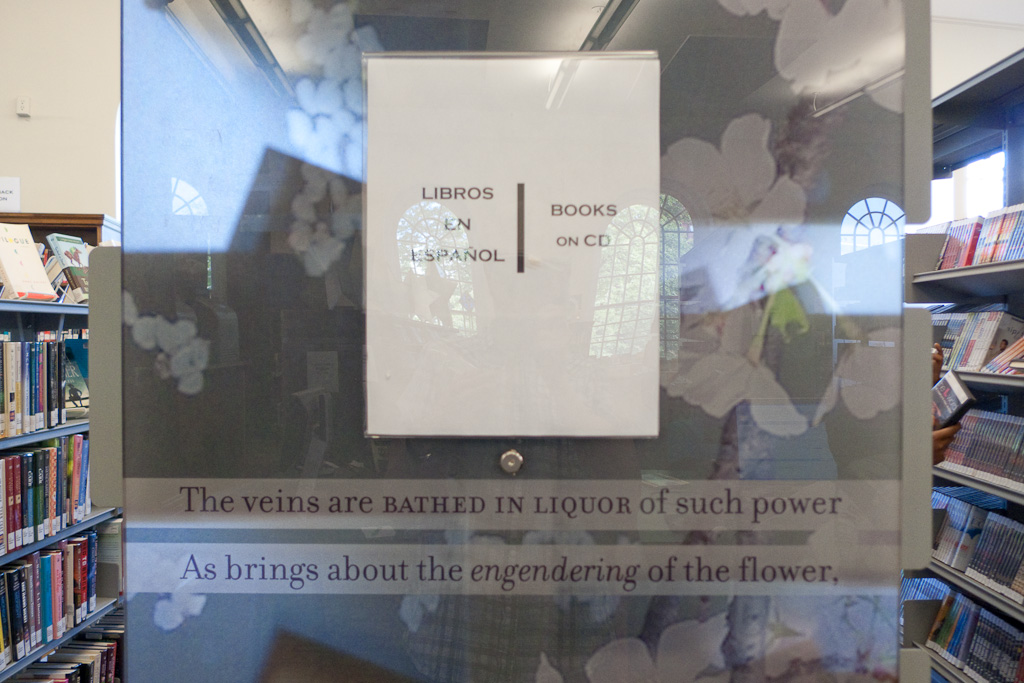
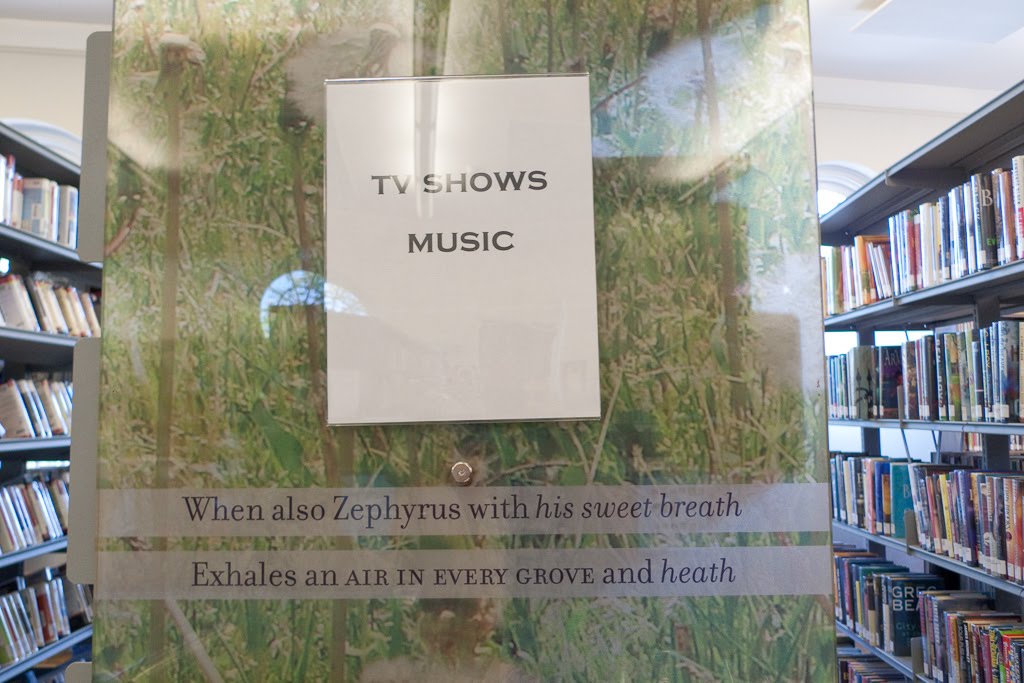
Yesterday I popped into the DC Public Library, SE Branch and noticed an intriguing decorative motif: April-themed lines from Geoffrey Chaucer's The Canterbury Tales adorned the bookshelves (original Middle English along one set of bookcases, and a modern English translation on the other). Above, a snippet from the original text. Let's take a closer look at the translation, shall we?

"What that Aprille with his shoures soote/The droght of March hath perced to the roote" = When in April the SWEET SHOWERS FALL/And pierce the drought of March to the root, & all [I don't know why random words are in italics or capital letters. Overall it's pretty good; interesting that "the sweet showers" are now the grammatical subject, not April itself (himself)].

"And bathed every veyne in swich licour/Of which vertu engendred is the flour" = The veins are BATHED IN LIQUOR of such power/As brings about the engendering of the flower [seems pretty good - nice translation of "vertu" as "power" in order to make the lines rhyme].

"Whan Zephirus eek with his sweete breeth/Inspired hath in every holt and heeth" = When also Zephyrus with his sweet breath/Exhales AN AIR IN EVERY GROVE and heath [the words "breath" and "heath" don't rhyme in modern English, but otherwise this works].

"The tendre croppes, and the yonge sonne/Hath in the Ram his halve cours yronne" = UPON THE TENDER SHOOTS, and the young sun/His HALF-COURSE IN THE SIGN of the Ram HAS RUN [the "in the sign of the Ram" clarifies things for modern readers but the capital letters have gone crazy!].

"And smale foweles maken melodye,/That slepen al the nyght with open ye" = And the small fowl are making melody/That SLEEP AWAY THE NIGHT with open eye [here "melody" and "eye" no longer rhyme - not quite sure why "fowls" or "birds" wasn't used].

"(So priketh hem Nature in hir courages)/Than longen folk to goon on pilgrimages" = (So nature pricks them AND THEIR HEART ENGAGES)/Then PEOPLE LONG TO GO ON pilgrimages [creative translation here; "engages" works relatively well to set up the word "pilgrimages"].

"And palmeres for to seken straunge strondes,/To ferne halwes, kowthe in sondy londes" = And PALMERS LONG TO SEEK the stranger strands/Of far-off saints, hallowed in sundry lands [the phrase "stranger strands" and insertion of "saints" here is slightly odd, but I like the reincorporation of longing in this couplet].

"And specially from every shires ende/Of Engelond to Caunterbury they wende" = And specially, from every shire's end/Of England, down to Canterbury THEY WEND [I think it would have made more sense to translate "specially" as "especially" or "particularly"].

Overall, quite good - some awkward moments, but the modernization does attempt to preserve the original rhyme pattern.

P.S. Note that the final couplet to the opening lines has been omitted: "The hooly bilsful martir for to seke,/That hem hath holpen, whan that they were seke" [To seek the holy blissful martyr, who has helped them (pilgrims/palmers) whenever they were sick]. Not quite sure why these last two lines have been left out. Did the library simply run out of shelves? This is a public library, and I wonder (this being DC) if the lines were left out in order to preserve a more secular, nonsectarian theme and avoid the appearance of endorsing any particular religion.

Wednesday, April 21, 2010

Chinese in Civil War Teaser Ad

On the metro today, I saw this intriguing ad promoting an upcoming exhibit on the Civil War at that will go on display at the National Archives. The Chinese document pictured here certainly got my attention - I'll be curious to see what it's doing in the exhibit!

I can't make out everything in this text, but I do notice the words 大清 (Dà Qīng) at the top of a few of the lines, referring (I suppose) to the Great Qing Empire (last ruling dynasty of China). I guess this exhibit will reveal some connection between Qing China and the US Civil War?

For more on the upcoming "Discovering the Civil War" exhibit, see the official website (with teaser video).

P.S. (added September 2010) - Just noticed a new teaser ad on the metro:

It reads: "Emma or Frank? Women could not enlist, but hundreds of women served." Certainly an intriguing image and caption. Part II of the Civil War exhibit begins in November 2010.

Tuesday, April 20, 2010

Bewildering DC License Plate

Apparently this District resident likes not having a voting representative in Congress? Go figure.
Capitol Hill, a few days ago.

(Note that you can just make out the words TAXATION WITHOUT REPRESENTATION on the bottom this license plate.)

Thursday, April 8, 2010

Library of Congress: Inventors of Writing (Odin)

Here's one last figure from the bronze doors to the Adams Building (Library of Congress). Here we see Odin (Óðinn in Old Norse), the Germanic god; I assume he's on this wall because he's believed to have invented runes or something...but don't know much about Norse mythology.

To read about some of the other figures on these doors, see here and here.

Library of Congress: Inventors of Writing (Cadmus)

Here's another figure from the bronze doors on the Adams Building (Library of Congress). Here we see Cadmus (Κάδμος), the man who - according to the historian Herodotus - introduced the alphabet (Phoenician script) to the ancient Greeks. Interesting that the sculptor here (Lee Lawrie, 1939) made no attempt to replicate Greek letters (i.e., the name "CADMUS" is written in Roman capitals).

For more images from the bronze doors, see the previous post.

For more Greek stuff from the Library of Congress, see this posting.

Wednesday, April 7, 2010

Library of Congress: Inventors of Writing (Cang Jie)

The bronze doors on the west side of the Adams Building of the Library Congress depict mythological and historical figures who are (for some reason or another) closely associated with writing. Above, a figure representing 倉頡 (Cāng Jié), the legendary four-eyed inventor of Chinese characters.

There are two different systems for writing Mandarin Chinese characters, including traditional and simplified; in simplified script the name is written 仓颉. Note that there are (at least) two systems of Romanization for Chinese. The spelling "Ts'ang Chieh" (used in this inscription) is the antiquated Wide-Giles system which has since fallen out of use; it's generally considered standard procedure to use Pinyin Romanization.

P.S. The bronze doors were sculpted by Lee Lawrie in 1939.

For more figures from these bronze doors, see the following post.

Garden Store

Spring is here. Who is this guy Herb, and why is he in the backyard? Capitol Hill.