Last weekend I checked out the National Book Festival (annual event on the Mall organized by the Library of Congress) and brought back some great bookmarks. On the right, a bookmark publicizing the World Digital Library, an international archive of cultural treasures maintained by UNESCO and the Library of Congress; its mission is to disseminate knowledge and increase cross-cultural understanding. The bookmark uses 5 languages: English, Arabic, Russian, French, (Mandarin) Chinese, and Spanish - these are, fittingly enough, the 5 official languages of the UN. To access this amazing digital library, go here.
My favorite bookmark is on the bottom left; the slogan states "Reading is for everyone," and superimposed on this is the equivalent text in raised Braille dots. These materials promote the National Library Service's resources for the blind.
Saturday, October 2, 2010
"One Nation" Logo
A timely follow-up to yesterday's posting about flags: this sign for the "One Nation Working Together" March on DC. Today, October 2, 2010, marks the progressive, social justice answer to the Glenn Beck/FOX News rally that was in town a few weeks ago. Appropriately, the logo features a stylized American flag with the numeral "1" as the basis for a stylized "N" (for "nation").
(You can learn more about the march and the coalition of groups that make up the organization at this website).
Friday, October 1, 2010
The Language of Flags - US States etc.
This city abounds with flags - and not just in government buildings. In front of Union Station you can see the flags of all 50 states in the order they were admitted into the Union. Above (from L to R), the most recent states (Oklahoma, New Mexico, Arizona, Alaska, and Hawaii), then DC, and finally all the other US territories and commonwealths (Puerto Rico, Guam, American Samoa, US Virgin Islands, and Northern Mariana Islands).
Vexillology, the study of flags, employs an arcane lexicon that ultimately derives from medieval heraldry (see this website for some of this vocabulary). I would describe the Hawaiian flag (just right of center in the photo above) as something like "the British flag in the top-left corner with stripes on the rest of it" but the flag is officially described in these terms:
[From The Hawaii Revised Statues, Vol. 1, Ch. 5, Sec. 19 - see here]
The DC flag, above (center), is commonly understood to have heraldic origins (see my earlier posting for a fuller description).
I think that the most attractive use of flags as a decorative motif in a building is in the Kennedy Center. In the grand Hall of Nations, flags appear in alphabetical order by country name. Above, we see Australia (top left) followed by A's and B's.
In the equally-grand Hall of States, the flags are arranged chronologically according to date they were admitted into the Union. The flags begin with Delaware (in the back right) and proceed toward the front of the right-hand wall; they they start up again on the left-hand wall (front left of this photo) and proceed to the end, followed by the US "non-states."
For more on each of the 50 state flags, see this website.
Vexillology, the study of flags, employs an arcane lexicon that ultimately derives from medieval heraldry (see this website for some of this vocabulary). I would describe the Hawaiian flag (just right of center in the photo above) as something like "the British flag in the top-left corner with stripes on the rest of it" but the flag is officially described in these terms:
(1) The Hawaiian flag shall consist of eight horizontal stripes, alternately white, red, blue, etc., beginning at the top, having a jack cantoned in the dexter chief angle next to the point of suspension;
(2) The jack shall consist of a blue field charged with a compound saltire (crossing) of alternate tincture white and red, the white having precedence; a narrow edge of white borders each red side of the saltire;
(3) A red cross bordered with white is charged (placed) over all.[From The Hawaii Revised Statues, Vol. 1, Ch. 5, Sec. 19 - see here]
The DC flag, above (center), is commonly understood to have heraldic origins (see my earlier posting for a fuller description).
I think that the most attractive use of flags as a decorative motif in a building is in the Kennedy Center. In the grand Hall of Nations, flags appear in alphabetical order by country name. Above, we see Australia (top left) followed by A's and B's.
In the equally-grand Hall of States, the flags are arranged chronologically according to date they were admitted into the Union. The flags begin with Delaware (in the back right) and proceed toward the front of the right-hand wall; they they start up again on the left-hand wall (front left of this photo) and proceed to the end, followed by the US "non-states."
For more on each of the 50 state flags, see this website.
Labels:
architecture,
flag,
heraldry,
kennedy center,
semiotics,
union station
Wednesday, September 29, 2010
The Language of Flags - DC
Above, the distinctive flag of the District of Columbia. Its stars and stripes evoke the US (federal) flag, but most descriptions say the DC flag design derives from the coat of arms of George Washington's family (see here for more on the flag's origins).
Here's the Washington family shield as it appears in 14th-century stained glass on a window in Selby Abbey, Yorkshire (England). In proper heraldic vocabulary, these design motifs should be designated as "mullets and bars" and not "stars and stripes" (see the last section of this page). For more about the Washington Window at Selby Abbey, see here. For an extensive website exploring the rich legacy of Washington's arms in American culture, see here.
I was trying to find out more about the symbolism of the DC flag but the website on DC symbols wasn't that informative. For what it's worth, I have heard somewhere (was it on a Capitol tour?) that the three stars represent the branches of government (executive, legislative, and judicial) and bars symbolize equality. This could be an urban legend or even some sort of ironic political commentary - since DC residents lack equal legislative representation in Congress (i.e., DC has no voting representative). For more on the DC voting rights issue and how the flag is used on both sides of the issue, see this alternate version of the DC flag and this DC license plate).
Here's the Washington family shield as it appears in 14th-century stained glass on a window in Selby Abbey, Yorkshire (England). In proper heraldic vocabulary, these design motifs should be designated as "mullets and bars" and not "stars and stripes" (see the last section of this page). For more about the Washington Window at Selby Abbey, see here. For an extensive website exploring the rich legacy of Washington's arms in American culture, see here.
I was trying to find out more about the symbolism of the DC flag but the website on DC symbols wasn't that informative. For what it's worth, I have heard somewhere (was it on a Capitol tour?) that the three stars represent the branches of government (executive, legislative, and judicial) and bars symbolize equality. This could be an urban legend or even some sort of ironic political commentary - since DC residents lack equal legislative representation in Congress (i.e., DC has no voting representative). For more on the DC voting rights issue and how the flag is used on both sides of the issue, see this alternate version of the DC flag and this DC license plate).
Labels:
architecture,
church,
flag,
government,
heraldry,
medieval,
semiotics,
uk
Creative Logo (Department of Transportation)
Today I spotted this logo on a construction vehicle as workers were repaving part of the street. The logo bears the DC flag, and below a lower-case "d" and a punctuation mark (period). District Department of Transportation = D-DOT. Get it? (This logo also appears on the D-DOT website.) Capitol Hill.
(For another use of the DC flag, see this license plate.)
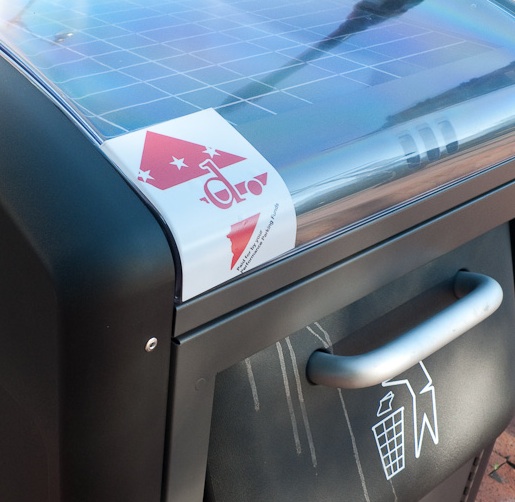
[Added Oct 1, 2010] Just noticed this brand new solar trash compactor (yes, this is what DC tax dollars pay for!) at Eastern Market. A snazzier version of the D-DOT logo superimposed upon a DC flag (colors reversed) and a map indicating the shape of the District.
(For another use of the DC flag, see this license plate.)
[Added Oct 1, 2010] Just noticed this brand new solar trash compactor (yes, this is what DC tax dollars pay for!) at Eastern Market. A snazzier version of the D-DOT logo superimposed upon a DC flag (colors reversed) and a map indicating the shape of the District.
Labels:
capitol hill,
flag,
government,
logo,
map,
semiotics,
technology,
transportation
Tuesday, September 28, 2010
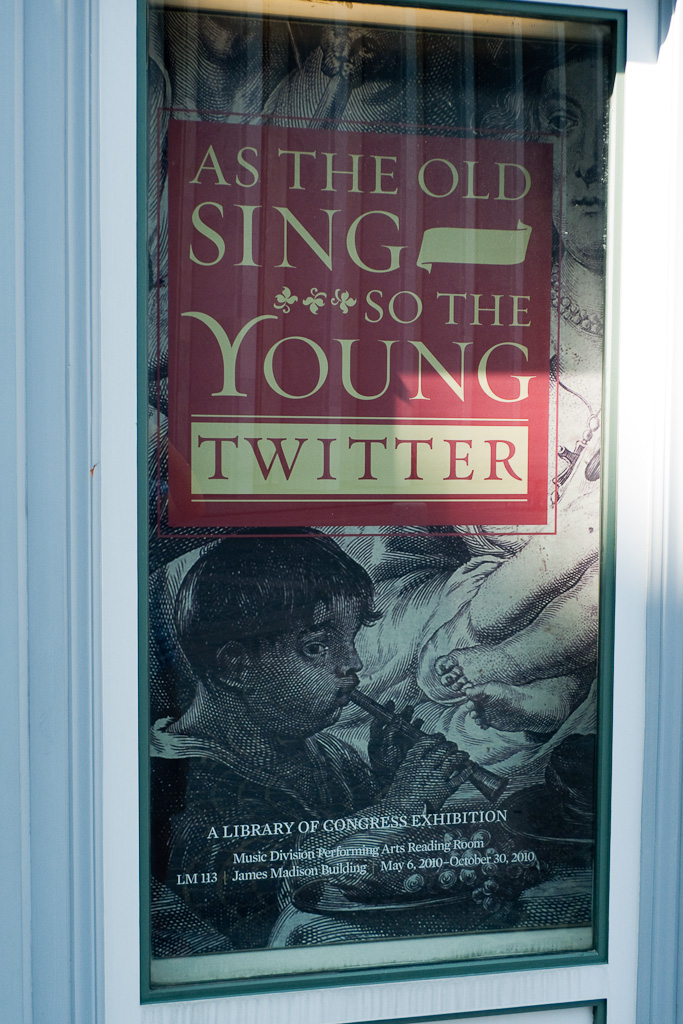
As the Old Sing, So the Young Twitter
I was mildly disappointed when I walked into the Library of Congress to discover that this exhibition is NOT about social media. Instead, "As the Old Sing, So the Young Twitter" explores the long-standing relationship between human music-making (via flute instruments) and birdsong. If you happen to be walking by the LOC Madison Building, it's worth a look. Exhibition ends October 30, 2010.
Labels:
library,
library of congress,
museum,
music,
technology
German, American, and Chinese Poems (Community)
I've walked passed the Goethe-Institut in Chinatown many times (see an earlier post), but usually I keep on walking. A few days ago, something caught my eye: these posters displaying German, American, and Chinese poems. These posters are part of "Time Shadows," an annual competition that features poems from each culture. The theme for 2010 is "Community."
This Chinese poem by a poet from Taiwan is entitled 望夫石 ("Husband-Gazing Stone"). The German translation states that this poem concerns "die Legende von der Ehefrau, die so lange nach ihrem verschollenen Ehemann Ausschau hielt, bis sie sich in einen Stein verwandelte" [the legend of a wife who kept watch for her missing husband for so long that she transformed into a stone]. You can read the poem and its English and German translations at this website.
I found this excerpt from the work of an American poet particularly interesting. This poem, entitled "Locals," reminds us that all of our ancestors ultimately come from "somewhere else," displacing whoever was there before. The poem offers an insightful commentary on the ever-shifting nature of community and the constant migration of people over time and space. The final 2 stanzas in the original English text read as follows:
Bedouin-Brython-Algonquins; always there
before you; the original prior claim
that made your being anywhere intrusive.
There, doubtless, in Eden before Adam
wiped them out and settled in with Eve.
Whether at home or away, whether kids
playing or saying what they wanted,
or adults chatting, waiting for a bus,
or, in their well-tended graves, the contented dead,
there were always locals, and they were never us.
See this website for the entire poem in English, plus translations in Chinese and German.
For a poem from the "Time Shadows 2009" competition (the theme was "City Life"), see this earlier post or this website.
This Chinese poem by a poet from Taiwan is entitled 望夫石 ("Husband-Gazing Stone"). The German translation states that this poem concerns "die Legende von der Ehefrau, die so lange nach ihrem verschollenen Ehemann Ausschau hielt, bis sie sich in einen Stein verwandelte" [the legend of a wife who kept watch for her missing husband for so long that she transformed into a stone]. You can read the poem and its English and German translations at this website.
I found this excerpt from the work of an American poet particularly interesting. This poem, entitled "Locals," reminds us that all of our ancestors ultimately come from "somewhere else," displacing whoever was there before. The poem offers an insightful commentary on the ever-shifting nature of community and the constant migration of people over time and space. The final 2 stanzas in the original English text read as follows:
Bedouin-Brython-Algonquins; always there
before you; the original prior claim
that made your being anywhere intrusive.
There, doubtless, in Eden before Adam
wiped them out and settled in with Eve.
Whether at home or away, whether kids
playing or saying what they wanted,
or adults chatting, waiting for a bus,
or, in their well-tended graves, the contented dead,
there were always locals, and they were never us.
See this website for the entire poem in English, plus translations in Chinese and German.
For a poem from the "Time Shadows 2009" competition (the theme was "City Life"), see this earlier post or this website.
Monday, September 27, 2010
"Formosa Betrayed" Poster
Poster for the political thriller "Formosa Betrayed" = 出賣的台灣. The verb 出賣 (chū mài) = to sell out or betray. Although the Chinese text uses the name "Taiwan" (台灣 in traditional script), the name in the English movie title is "Formosa," from the Portuguese name given to the island ("Ilha Formosa" = beautiful island). February 2010, Foggy Bottom.
Synagogue to Church (Judeo-Christian Palimpsest)
The building now known as the Tried Stone Church of Christ was once a synagogue. The Southeast Hebrew Congregation was founded on Capitol Hill by Orthodox immigrants from Eastern Europe in 1909, and after World War II this house of worship was built. The congregation relocated to Silver Spring, MD in 1971. When the church acquired this property, the new congregation changed the name of the building but retained the Ten Commandments (inscribed in Hebrew) which were part of the original entrance façade.
Above, a photo from early in 2008 before the entrance sign was changed. How fitting that different periods in the building's history are visible in the layers of stone and brick.
P.S. For a more famous appearance of the Ten Commandments in DC, see this post. See also this torah ark.
Above, a photo from early in 2008 before the entrance sign was changed. How fitting that different periods in the building's history are visible in the layers of stone and brick.
P.S. For a more famous appearance of the Ten Commandments in DC, see this post. See also this torah ark.
Labels:
architecture,
capitol hill,
church,
culture,
hebrew,
jewish,
religion,
synagogue
Subscribe to:
Posts (Atom)