Showing posts with label medieval. Show all posts
Sunday, August 5, 2012
Clockwise Shadows (Smithsonian Castle)
Sundial, Smithsonian Castle Garden, August 5, 2012. 1:15 pm. Latin inscription (left on this photo): Aspice, Respice, Prospice = "Look Around, Look Back, and Look Forward" (or, more loosely translated, "Observe, Reflect, and Think Ahead").
Some observations: You'll see that "north" (and 12 o'clock) on the middle right in this photo; I oriented the image to better reveal the shadow of the gnomon (rod) that's indicating the time. Over the course of a day, the Sun causes the shadow to around the sundial in a "clockwise" direction. The only reason mechanical clocks go "clockwise" is that they follow the motion established by earlier sundials - if sundials (and clocks) had been invented in the Southern Hemisphere, they'd now be going in the "other" direction.
Numbers on the clock are indicated in Roman numerals. The number "four" is indicated as IIII, after the Roman fashion; the form "IV" was actually a later (medieval) development.
Labels:
garden,
latin,
medieval,
smithsonian,
technology
Tuesday, March 8, 2011
Chinese Silkweaving, Multiple Scripts
During a visit to the Freer Gallery of Art last year, I came across this 13th-century scroll painting that depicts the art of Chinese silkweaving. The scroll links together 24 sheets of paper unfurling from left to right, and its visual content is fascinating (the scenes represent all the stages of silk production). Its verbal content is interesting as well. Each scene is accompanied by a poem that is written out in a formal style of calligraphy called "seal script." Next to each character of text in the poem there's a tiny gloss "translating" the character into standard script. There are also various inscriptions in "running script" throughout the scroll, in addition to the seals of multiple owners that have accrued over time.
To see more images of the scroll and download detailed documentation about its contents, see this website.
Labels:
art,
calligraphy,
chinese,
cultural,
medieval,
museum,
national mall,
painting,
technology
Sunday, January 23, 2011
Jibberish Scripts (Hebrew? Greek?)
A holy child writes in a book in this detail from Bernhard Strigel's Saint Mary Salome and Her Family in the National Gallery of Art (click image to enlarge). I was intrigued by the appearance of the writing in this book, which looks to me like jibberish script. At first I thought these letter-forms were approximating Hebrew, but if that's so then the writing is going in the wrong direction (i.e., the pen is moving left to right, as one does when writing Latin and other languages; Hebrew should go from right to left).
When I took another look at the entire painting online (see image and description here), I realized this child actually identified as SANCTV. IOHANES EWAN. (Saint John the Evangelist) - and his Gospel was actually written in Greek. But the writing doesn't look very much like Greek either.
I guess it doesn't really matter whether the writing is "supposed" to be Greek or Hebrew. It looks like the artist was much more interested in representing the "idea" of a holy writer rather than conveying the accuracy of any particular script. (For another creative use of script in a religious painting, see this earlier posting about upside-down Latin.)
I'm sure I could find other examples of jibberish script throughout the NGA if I really looked around, but here's a similar example from a painting I saw in the Museo dell'Opera del Duomo during a visit to Siena:
I don't remember who this figure is or even the name of the artist, but it's another intriguing example of visually stylized script that lends an aura of authority. Whether it's meant to represent Hebrew or Greek, the symbols here look to me a lot like a older form of Arabic numerals.
When I took another look at the entire painting online (see image and description here), I realized this child actually identified as SANCTV. IOHANES EWAN. (Saint John the Evangelist) - and his Gospel was actually written in Greek. But the writing doesn't look very much like Greek either.
I guess it doesn't really matter whether the writing is "supposed" to be Greek or Hebrew. It looks like the artist was much more interested in representing the "idea" of a holy writer rather than conveying the accuracy of any particular script. (For another creative use of script in a religious painting, see this earlier posting about upside-down Latin.)
I'm sure I could find other examples of jibberish script throughout the NGA if I really looked around, but here's a similar example from a painting I saw in the Museo dell'Opera del Duomo during a visit to Siena:
I don't remember who this figure is or even the name of the artist, but it's another intriguing example of visually stylized script that lends an aura of authority. Whether it's meant to represent Hebrew or Greek, the symbols here look to me a lot like a older form of Arabic numerals.
Wednesday, September 29, 2010
The Language of Flags - DC
Above, the distinctive flag of the District of Columbia. Its stars and stripes evoke the US (federal) flag, but most descriptions say the DC flag design derives from the coat of arms of George Washington's family (see here for more on the flag's origins).
Here's the Washington family shield as it appears in 14th-century stained glass on a window in Selby Abbey, Yorkshire (England). In proper heraldic vocabulary, these design motifs should be designated as "mullets and bars" and not "stars and stripes" (see the last section of this page). For more about the Washington Window at Selby Abbey, see here. For an extensive website exploring the rich legacy of Washington's arms in American culture, see here.
I was trying to find out more about the symbolism of the DC flag but the website on DC symbols wasn't that informative. For what it's worth, I have heard somewhere (was it on a Capitol tour?) that the three stars represent the branches of government (executive, legislative, and judicial) and bars symbolize equality. This could be an urban legend or even some sort of ironic political commentary - since DC residents lack equal legislative representation in Congress (i.e., DC has no voting representative). For more on the DC voting rights issue and how the flag is used on both sides of the issue, see this alternate version of the DC flag and this DC license plate).
Here's the Washington family shield as it appears in 14th-century stained glass on a window in Selby Abbey, Yorkshire (England). In proper heraldic vocabulary, these design motifs should be designated as "mullets and bars" and not "stars and stripes" (see the last section of this page). For more about the Washington Window at Selby Abbey, see here. For an extensive website exploring the rich legacy of Washington's arms in American culture, see here.
I was trying to find out more about the symbolism of the DC flag but the website on DC symbols wasn't that informative. For what it's worth, I have heard somewhere (was it on a Capitol tour?) that the three stars represent the branches of government (executive, legislative, and judicial) and bars symbolize equality. This could be an urban legend or even some sort of ironic political commentary - since DC residents lack equal legislative representation in Congress (i.e., DC has no voting representative). For more on the DC voting rights issue and how the flag is used on both sides of the issue, see this alternate version of the DC flag and this DC license plate).
Labels:
architecture,
church,
flag,
government,
heraldry,
medieval,
semiotics,
uk
Saturday, September 25, 2010
London: Churches and Museums
Various items from churches and museums in London.
This sign for the Chinese Church in London features a nicely stylized form of the Chinese word 華 (huá), which means "China" or "Chinese" in most contexts. Here, a "cross" (or Star of Bethlehem) motif is incorporated into the center of the character.
Near the church, in Chinatown, I saw this poster that teaches children the Pinyin romanization scheme for Chinese. Each sound in Mandarin is assigned a corresponding Roman letter. Most of the words chosen are simple, everyday ideas or objects: 大 (dà) = big, large; 土 (tǔ) = earth, dust. I'm confused by the image for for 你 (nǐ) - I always thought it just mean "you."
St. Dunstan in the West is a church that caters to the demographics of its congregation in a variety of ways. Here, an entrance sign asks visitors to pray for peace (in English, French, German, Russian, Greek, and Romanian). Although the church is Anglican, I noticed many (Greek and Romanian) Orthodox icons and motifs inside. The praying hands are, I suppose, German in origin, after Betende Hände by Albrecht Dürer (c. 1508).
All Hallows by the Tower isn't one of London's most famous churches but it's worth a visit (check out the crypt and the brass rubbing center). Some notable people associated with the church include William Penn (baptized here, 1644) John Quincy Adams (married here, 1797), and Thomas More (beheaded near here, 1535).
The crypt underneath the church allows you to view centuries of treasures. The medieval livery companies of London contributed funds to develop this space to display valued artifacts and documents. Appropriately, a French inscription reads "Conservez ce qu'ont vu vos peres" [Safeguard those things upon which your fathers have looked]. Why French? It's the language medieval guilds used in most of their administrative and civic documents.
There are maritime motifs all throughout the church itself (among other things, there's a Mariners Chapel). This heraldic device is the emblem of the old Royal Mail Steam Packet Company, which bore the Latin motto "Per Mare Ubique" [Everywhere By Sea]. What I find most curious is the use of sea horses as supporters for the shield device! Apparently sea horses do appear elsewhere in heraldic insignia but in more imaginative and stylized forms; see this website (scroll to "sea-horse") for other examples.
I end with this curious detail from a medieval comic strip (or "graphic novel") version of the Book of Revelations. This panel depicts Rev. 16:13-16, when the text describes "three unclean spirits like frogs" coming out of the mouth of the False Prophet, Dragon, and Beast. Read (and hear) more about this artwork, with larger image, at this Victoria and Albert Museum website.
This sign for the Chinese Church in London features a nicely stylized form of the Chinese word 華 (huá), which means "China" or "Chinese" in most contexts. Here, a "cross" (or Star of Bethlehem) motif is incorporated into the center of the character.
Near the church, in Chinatown, I saw this poster that teaches children the Pinyin romanization scheme for Chinese. Each sound in Mandarin is assigned a corresponding Roman letter. Most of the words chosen are simple, everyday ideas or objects: 大 (dà) = big, large; 土 (tǔ) = earth, dust. I'm confused by the image for for 你 (nǐ) - I always thought it just mean "you."
St. Dunstan in the West is a church that caters to the demographics of its congregation in a variety of ways. Here, an entrance sign asks visitors to pray for peace (in English, French, German, Russian, Greek, and Romanian). Although the church is Anglican, I noticed many (Greek and Romanian) Orthodox icons and motifs inside. The praying hands are, I suppose, German in origin, after Betende Hände by Albrecht Dürer (c. 1508).
All Hallows by the Tower isn't one of London's most famous churches but it's worth a visit (check out the crypt and the brass rubbing center). Some notable people associated with the church include William Penn (baptized here, 1644) John Quincy Adams (married here, 1797), and Thomas More (beheaded near here, 1535).
Friday, September 24, 2010
Paris: English vs. French
Earlier this summer I saw an exhibit in the Musée de l'Armée about the work of Jean Froissart, a medieval historian who wrote extensively about the Hundred Years' War between England and France (a misnomer, since the war actually lasted over 100 years).
Here's the poster for the exhibition. The title translates as "JOHN FROISSART chronicler of the Hundred Years' War." Note the use of red in the title - this follows the medieval practice of rubrication in manuscripts (i.e., using red letters to signal important textual features like titles or section headings). Colors - particularly red and blue - were used in some interesting ways throughout the exhibit as well.
This medieval manuscript shows the King of England (L, dressed in red, with lions) speaking with the King of France (R, dressed in blue, with fleur-de-lis motif). These are traditional heraldic devices/colors associated with the two nations.
The family tree near the start of the exhibit actually uses these heraldic motifs to mark royal family lines (England red, France blue). But look what happens when Henry V of England and French princess Catherine de Valois bear a child: Henry VI is rendered in alternating red and blue. Reminds me of a line in Shakespeare when the English king woos Catherine and suggests that "thou and I" shall bear a "compound...boy, half French, half English" (Henry V, Act 5.2).
The color-coding gets more complicated in the war chronology: events in English history are listed in blue, events in French history are in red, and events in the shared history of the nations are in green.
This little panel describes pieces of armor worn by soldiers during the period. In the center, a nice little riddle about a chain-mail garment (in parallel translation). Not quite sure why they "re-translated" the word "haubergon" in the French but not in the English.
Insofar as English/French relations are concerned, there seems to be a love/hate dynamic throughout the museum as a whole. The displays often stress solidarity between the Allies during World War II (in this context, the English are clearly friends and supporters of the French), but other materials openly mock the English. This satirical poster mocks "les English" on their way to Transvaal (in South Africa). Above, they cry for glory and victory shouting AO YES! Below, they disembark the ships onto the land, seasick and full of "wisky."
P.S. Just noticed in the royal pedigree that "Edouard" is not anglicized to Edward, but Henry is spelled in the English way (in French it would be spelled "Henri"). Weird.
Tuesday, September 7, 2010
Florence Edition: Dante
It's been months since I posted anything new here - much of the summer was spent away from DC. Just for fun, I'll be blogging about a few of the places I visited. I start with Florence.
The theme for this blog entry about Florence is Dante: signs of this renowned poet (d. 1321) can be found all throughout the city.
A detail of Dante's book reveals the opening lines of his poem. A little hard to read, since 1. the text appears in all capital letters with no word separations and 2. the spelling differs from most modern editions. The first page (left) reads: "Nel mezzo del chamino di nostra vita / Mi ritrova per una selva scura che la diritta via era smarita" [In the middle of our life's journey / I found myself in a dark wood, for the straight path was lost].
Many other signs evoking the works of Dante are strategically placed around the city; e.g., at one point along the Ponte Vecchio (Old Bridge) crossing the Arno River, we see "in sul passo d'Arno" [at the crossing of the Arno]. Mildly interesting sign, I guess - but without any real context for the quote it seems pretty random. I wonder if most people even notice it.
One place of particular interest for Dante readers is the Casa di Dante, where the poet (most likely) once resided. There's much to love about this wall display - not only does it have a nice diagram of all of Dante's circles of hell, but it also manages to squeeze in the entire text of The Divine Comedy on a single panel in tiny font! And how did those footprints get on the wall?
A Florence location that has become a curious site of pilgrimage is the Chiesa di Santa Margherita de' Cerchi, which is allegedly near the place where Dante first met his beloved Beatrice Portinari (i.e., the subject of his early poetry and, later, his guide in the Paradiso). The entrance sign informs visitors that the church dates from 1032 and Beatrice was buried here.
Inside the church, a painting: "Dante meets Beatrice P., accompanied by her mother Cilia de' Caponsacchi and Monna Tessa" [i.e., nurse in the Portinari household]. In the Vita Nuova, Dante claims he met Beatrice walking down the street with two ladies and this encounter inspired him to write poetry about her. This painting seems to take some liberties here, as Dante claims he was 18 at the time of that meeting (this Dante looks much older).
At the tomb of Beatrice, visitors from around the world leave handwritten letters to her (most of these are written by women who are seeking love and asking Beatrice to intercede). I can't make out all the text here, but the one on the right is in Korean; the one of the left (with lipstick) reads "Dear Beatrice."
The "letters for Beatrice" phenomenon is mysterious and surprisingly recent in origin. For more on Dante's life and work (emphasis on The Divine Comedy), see this excellent website.
P.S. There is a Florence-DC connection I should note! In Meridian Park, you can see a statue of Dante clearly based on the painting in the Duomo (or something very much like it):
This portrayal of Dante looks pretty familiar. I see one major difference between this sculpture and the Duomo painting, though. The Dante in the Duomo holds an open book, but this Dante has his book closed.
The theme for this blog entry about Florence is Dante: signs of this renowned poet (d. 1321) can be found all throughout the city.
In the Duomo, this spectacular painting (Domenico di Michelino, 1465) depicts the poet gazing longingly at the city of Florence (he wrote The Divine Comedy while in exile from his beloved home). On the left you see the Inferno and center is Mount Purgatory (as described in the Purgatorio). The celestial spheres of Paradiso are above. This painting beautifully transforms (translates, if you will) the grand scope of the poet's allegory into a clear visual format - although it depicts a city with architecture that Dante would not have known (the dome did not exist as such in his day).
Many other signs evoking the works of Dante are strategically placed around the city; e.g., at one point along the Ponte Vecchio (Old Bridge) crossing the Arno River, we see "in sul passo d'Arno" [at the crossing of the Arno]. Mildly interesting sign, I guess - but without any real context for the quote it seems pretty random. I wonder if most people even notice it.
One place of particular interest for Dante readers is the Casa di Dante, where the poet (most likely) once resided. There's much to love about this wall display - not only does it have a nice diagram of all of Dante's circles of hell, but it also manages to squeeze in the entire text of The Divine Comedy on a single panel in tiny font! And how did those footprints get on the wall?
A Florence location that has become a curious site of pilgrimage is the Chiesa di Santa Margherita de' Cerchi, which is allegedly near the place where Dante first met his beloved Beatrice Portinari (i.e., the subject of his early poetry and, later, his guide in the Paradiso). The entrance sign informs visitors that the church dates from 1032 and Beatrice was buried here.
Inside the church, a painting: "Dante meets Beatrice P., accompanied by her mother Cilia de' Caponsacchi and Monna Tessa" [i.e., nurse in the Portinari household]. In the Vita Nuova, Dante claims he met Beatrice walking down the street with two ladies and this encounter inspired him to write poetry about her. This painting seems to take some liberties here, as Dante claims he was 18 at the time of that meeting (this Dante looks much older).
At the tomb of Beatrice, visitors from around the world leave handwritten letters to her (most of these are written by women who are seeking love and asking Beatrice to intercede). I can't make out all the text here, but the one on the right is in Korean; the one of the left (with lipstick) reads "Dear Beatrice."
The "letters for Beatrice" phenomenon is mysterious and surprisingly recent in origin. For more on Dante's life and work (emphasis on The Divine Comedy), see this excellent website.
P.S. There is a Florence-DC connection I should note! In Meridian Park, you can see a statue of Dante clearly based on the painting in the Duomo (or something very much like it):
This portrayal of Dante looks pretty familiar. I see one major difference between this sculpture and the Duomo painting, though. The Dante in the Duomo holds an open book, but this Dante has his book closed.
Labels:
architecture,
church,
florence,
italian,
korean,
literature,
medieval,
museum,
painting,
religion
Sunday, April 25, 2010
Chaucer in DC (Modern English Translation)
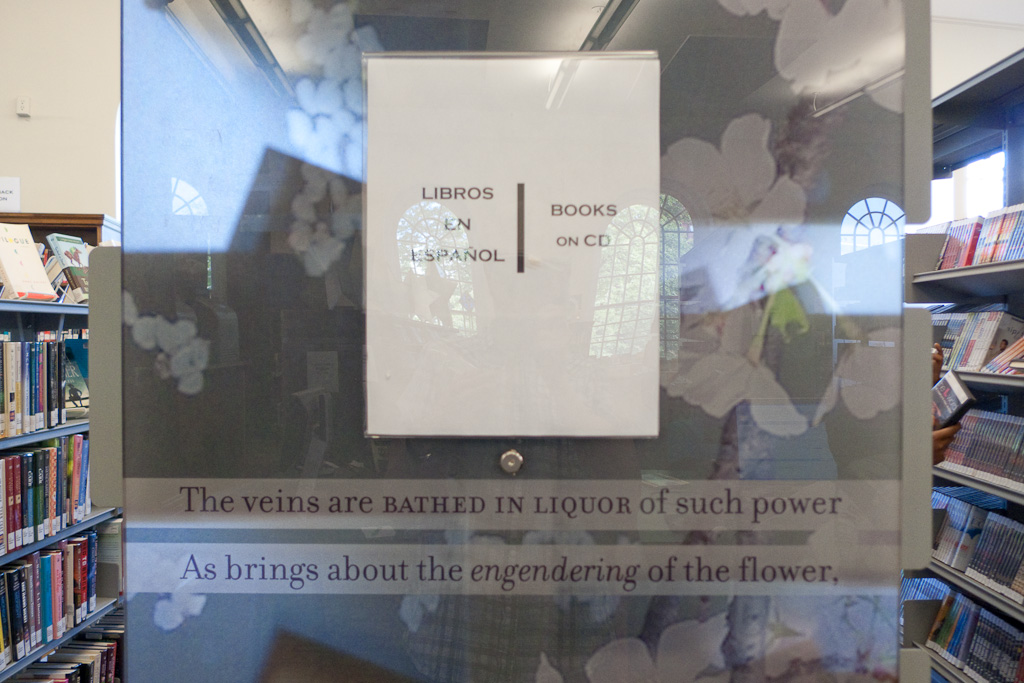
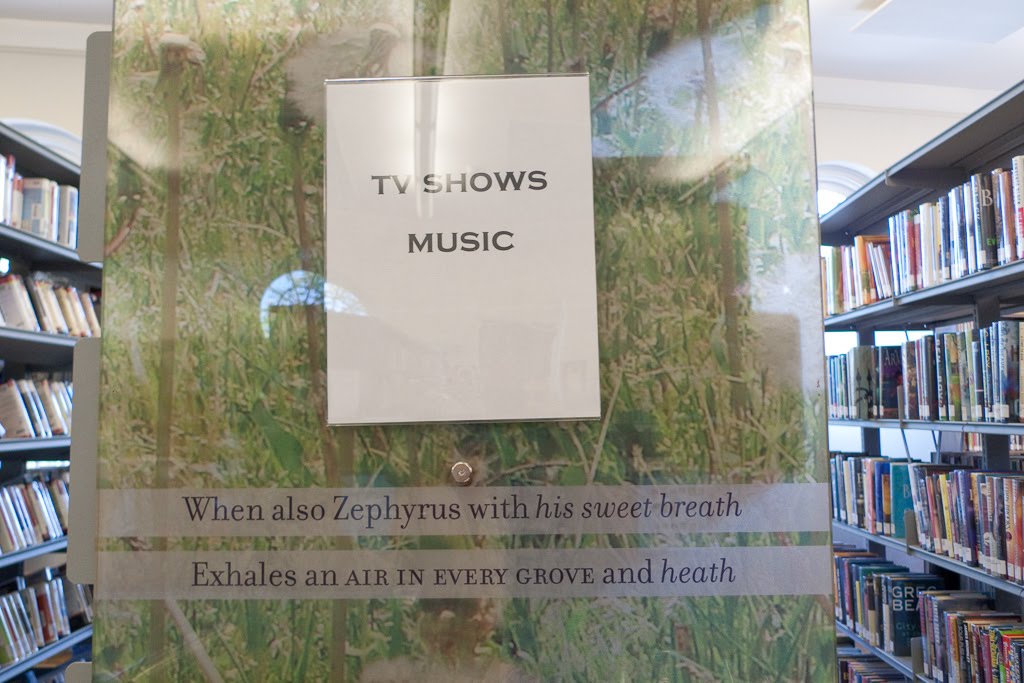
Yesterday I popped into the DC Public Library, SE Branch and noticed an intriguing decorative motif: April-themed lines from Geoffrey Chaucer's The Canterbury Tales adorned the bookshelves (original Middle English along one set of bookcases, and a modern English translation on the other). Above, a snippet from the original text. Let's take a closer look at the translation, shall we?
"What that Aprille with his shoures soote/The droght of March hath perced to the roote" = When in April the SWEET SHOWERS FALL/And pierce the drought of March to the root, & all [I don't know why random words are in italics or capital letters. Overall it's pretty good; interesting that "the sweet showers" are now the grammatical subject, not April itself (himself)].
"And bathed every veyne in swich licour/Of which vertu engendred is the flour" = The veins are BATHED IN LIQUOR of such power/As brings about the engendering of the flower [seems pretty good - nice translation of "vertu" as "power" in order to make the lines rhyme].
"Whan Zephirus eek with his sweete breeth/Inspired hath in every holt and heeth" = When also Zephyrus with his sweet breath/Exhales AN AIR IN EVERY GROVE and heath [the words "breath" and "heath" don't rhyme in modern English, but otherwise this works].
"The tendre croppes, and the yonge sonne/Hath in the Ram his halve cours yronne" = UPON THE TENDER SHOOTS, and the young sun/His HALF-COURSE IN THE SIGN of the Ram HAS RUN [the "in the sign of the Ram" clarifies things for modern readers but the capital letters have gone crazy!].
"And smale foweles maken melodye,/That slepen al the nyght with open ye" = And the small fowl are making melody/That SLEEP AWAY THE NIGHT with open eye [here "melody" and "eye" no longer rhyme - not quite sure why "fowls" or "birds" wasn't used].
"(So priketh hem Nature in hir courages)/Than longen folk to goon on pilgrimages" = (So nature pricks them AND THEIR HEART ENGAGES)/Then PEOPLE LONG TO GO ON pilgrimages [creative translation here; "engages" works relatively well to set up the word "pilgrimages"].
"And palmeres for to seken straunge strondes,/To ferne halwes, kowthe in sondy londes" = And PALMERS LONG TO SEEK the stranger strands/Of far-off saints, hallowed in sundry lands [the phrase "stranger strands" and insertion of "saints" here is slightly odd, but I like the reincorporation of longing in this couplet].
"And specially from every shires ende/Of Engelond to Caunterbury they wende" = And specially, from every shire's end/Of England, down to Canterbury THEY WEND [I think it would have made more sense to translate "specially" as "especially" or "particularly"].
Overall, quite good - some awkward moments, but the modernization does attempt to preserve the original rhyme pattern.
P.S. Note that the final couplet to the opening lines has been omitted: "The hooly bilsful martir for to seke,/That hem hath holpen, whan that they were seke" [To seek the holy blissful martyr, who has helped them (pilgrims/palmers) whenever they were sick]. Not quite sure why these last two lines have been left out. Did the library simply run out of shelves? This is a public library, and I wonder (this being DC) if the lines were left out in order to preserve a more secular, nonsectarian theme and avoid the appearance of endorsing any particular religion.
"What that Aprille with his shoures soote/The droght of March hath perced to the roote" = When in April the SWEET SHOWERS FALL/And pierce the drought of March to the root, & all [I don't know why random words are in italics or capital letters. Overall it's pretty good; interesting that "the sweet showers" are now the grammatical subject, not April itself (himself)].
"And bathed every veyne in swich licour/Of which vertu engendred is the flour" = The veins are BATHED IN LIQUOR of such power/As brings about the engendering of the flower [seems pretty good - nice translation of "vertu" as "power" in order to make the lines rhyme].
"Whan Zephirus eek with his sweete breeth/Inspired hath in every holt and heeth" = When also Zephyrus with his sweet breath/Exhales AN AIR IN EVERY GROVE and heath [the words "breath" and "heath" don't rhyme in modern English, but otherwise this works].
"The tendre croppes, and the yonge sonne/Hath in the Ram his halve cours yronne" = UPON THE TENDER SHOOTS, and the young sun/His HALF-COURSE IN THE SIGN of the Ram HAS RUN [the "in the sign of the Ram" clarifies things for modern readers but the capital letters have gone crazy!].
"And smale foweles maken melodye,/That slepen al the nyght with open ye" = And the small fowl are making melody/That SLEEP AWAY THE NIGHT with open eye [here "melody" and "eye" no longer rhyme - not quite sure why "fowls" or "birds" wasn't used].
"(So priketh hem Nature in hir courages)/Than longen folk to goon on pilgrimages" = (So nature pricks them AND THEIR HEART ENGAGES)/Then PEOPLE LONG TO GO ON pilgrimages [creative translation here; "engages" works relatively well to set up the word "pilgrimages"].
"And palmeres for to seken straunge strondes,/To ferne halwes, kowthe in sondy londes" = And PALMERS LONG TO SEEK the stranger strands/Of far-off saints, hallowed in sundry lands [the phrase "stranger strands" and insertion of "saints" here is slightly odd, but I like the reincorporation of longing in this couplet].
"And specially from every shires ende/Of Engelond to Caunterbury they wende" = And specially, from every shire's end/Of England, down to Canterbury THEY WEND [I think it would have made more sense to translate "specially" as "especially" or "particularly"].
Overall, quite good - some awkward moments, but the modernization does attempt to preserve the original rhyme pattern.
P.S. Note that the final couplet to the opening lines has been omitted: "The hooly bilsful martir for to seke,/That hem hath holpen, whan that they were seke" [To seek the holy blissful martyr, who has helped them (pilgrims/palmers) whenever they were sick]. Not quite sure why these last two lines have been left out. Did the library simply run out of shelves? This is a public library, and I wonder (this being DC) if the lines were left out in order to preserve a more secular, nonsectarian theme and avoid the appearance of endorsing any particular religion.
Labels:
culture,
eastern market,
library,
literature,
medieval
Thursday, April 8, 2010
Library of Congress: Inventors of Writing (Odin)
Here's one last figure from the bronze doors to the Adams Building (Library of Congress). Here we see Odin (Óðinn in Old Norse), the Germanic god; I assume he's on this wall because he's believed to have invented runes or something...but don't know much about Norse mythology.
To read about some of the other figures on these doors, see here and here.
Labels:
architecture,
art,
capitol hill,
culture,
library,
library of congress,
literature,
medieval,
museum,
norse
Saturday, January 23, 2010
Virtual Medieval Media (Interactive Gutenberg Bible)
Library of Congress, November 2009. I must say the interactive display accompanying the LOC's Gutenberg Bible is really cool. The Gutenberg Bible is of course one of the first texts in Western Europe to be produced using movable print technology. This touch-screen display allows you to navigate the text "virtually" (here, "hot spots" on the screen allow you to see chapter headings, rubrics, Latin abbreviations, etc.).
Another image from a different page in this bible. I find it interesting that so many of the terms we use to describe how we navigate digital media are simply imported from previous technologies: e.g., (web)page, scroll, tab, bookmark. There's something uncanny - familiar and yet strange - about navigating the "virtual" text in such a dynamic way while the original physical text remains inert in a stuffy display case just a few feet away.
Labels:
bible,
calligraphy,
latin,
library,
library of congress,
medieval,
museum,
technology
Friday, January 1, 2010
January in Almanac and Book of Hours
January 1, 2010. Happy New Year everyone!
I start the year with images from the Library of Congress copy of "Poor Richard's Almanack" (printed by Benjamin Franklin, Philadelphia, 1733). A "best seller" for decades in the American colonies, Franklin's annual "Almanack" included not only a calendar but astronomical and weather forecasts, witty maxims and puzzles, and practical advice.
The page for January (above) shows the astrological sign Aquarius and a domestic scene.
Each month's illustration is preceded by a calendar listing important days (religious festivals) and astronomical events.
Above, a detail of an anatomical man along with Zodiac signs.
Both the structure and layout of the "Almanack" owe much to the medieval book of hours (see this informative website for more). Compare the humble "Almanack" to the exquisite calendar and anatomical man in this 15th-century book, the "Tres Riches Heures" of Jean, Duc de Berry:
While the print "Almanack" is in English and the manuscript "Heures" in French/Latin, these books clearly participate in a shared visual tradition.
For more on the "Almanack" in the context of Franklin's work, see this Library of Congress website.
You can also view high-resolution images of each page of the LOC copy of the "Alamack" as well as a medieval book of hours.
For more information on the "Tres Riches Heures," see here and here.
I start the year with images from the Library of Congress copy of "Poor Richard's Almanack" (printed by Benjamin Franklin, Philadelphia, 1733). A "best seller" for decades in the American colonies, Franklin's annual "Almanack" included not only a calendar but astronomical and weather forecasts, witty maxims and puzzles, and practical advice.
The page for January (above) shows the astrological sign Aquarius and a domestic scene.
Above, a detail of an anatomical man along with Zodiac signs.
Both the structure and layout of the "Almanack" owe much to the medieval book of hours (see this informative website for more). Compare the humble "Almanack" to the exquisite calendar and anatomical man in this 15th-century book, the "Tres Riches Heures" of Jean, Duc de Berry:
While the print "Almanack" is in English and the manuscript "Heures" in French/Latin, these books clearly participate in a shared visual tradition.
For more on the "Almanack" in the context of Franklin's work, see this Library of Congress website.
You can also view high-resolution images of each page of the LOC copy of the "Alamack" as well as a medieval book of hours.
For more information on the "Tres Riches Heures," see here and here.
Labels:
art,
books,
culture,
library,
library of congress,
medieval,
technology
Wednesday, December 2, 2009
Upside-Down Latin
It's the season of Advent for many folks I suppose a 15th-century Annunciation image is appropriate. Jan van Eyck adapts Luke 1:26-38 (Archangel Gabriel tells the Virgin Mary she'll bear the Son of God). An inscription (left) bears Gabriel's words: AVE GRA[TIA] PLENA = "Hail, full of grace." Mary responds (right): ECCE ANCILLA D[OMI]NI = "Behold the handmaiden of the Lord."
Mary's words are upside-down. Is this so God can "see" (hear) her words?
A full picture of the image is below. National Gallery of Art, November 2009.
P.S. See this post for a different example of Latin speech in medieval art.
Sunday, November 29, 2009
Twisty Voice of God
What does the voice of God look like? "The Baptism of Christ" (late 15th century, by the Master of the St. Bartholomew Altar) depicts God's words using a banderole (speech scroll), the medieval equivalent of the comic book "speech balloon."
At this moment in Scripture, the Latin text (Vulgate Bible) describes a mysterious voice from the clouds ("ecce vox de nube, dicens" = lo! a voice out of the clouds, speaking). The painting transcribes the words of this voice on a curvy scroll unfurling from the sky: HIC EST FILIVS MEVS DILECTV[S] IN QUO MIHI BENE COMPLACVI = "This is my beloved son, in whom I am well pleased" (Matthew 17:5).
I'm intrigued by the curvy word scroll here; its shape forces you to read the twisting words "out of order." Does the sinuous scroll actually evoke the shape of nimbus clouds? Or do the twists and turns of the scroll evoke the ethereal sound of a cloudy voice from the heavens?
National Gallery of Art, November 2009.
Subscribe to:
Posts (Atom)